
Software Engineering and Agentic Coding

What building a production harness for agentic coding says about how much software engineering is still left to do July 2026 — Chandra Pendyala ABSTRACT: Most production-grade code-generation models have crossed a real usefulness threshold; the question that matters now is not which model to buy but what workflow surrounds it. Two structural facts keep […]
The Optimizer Gap
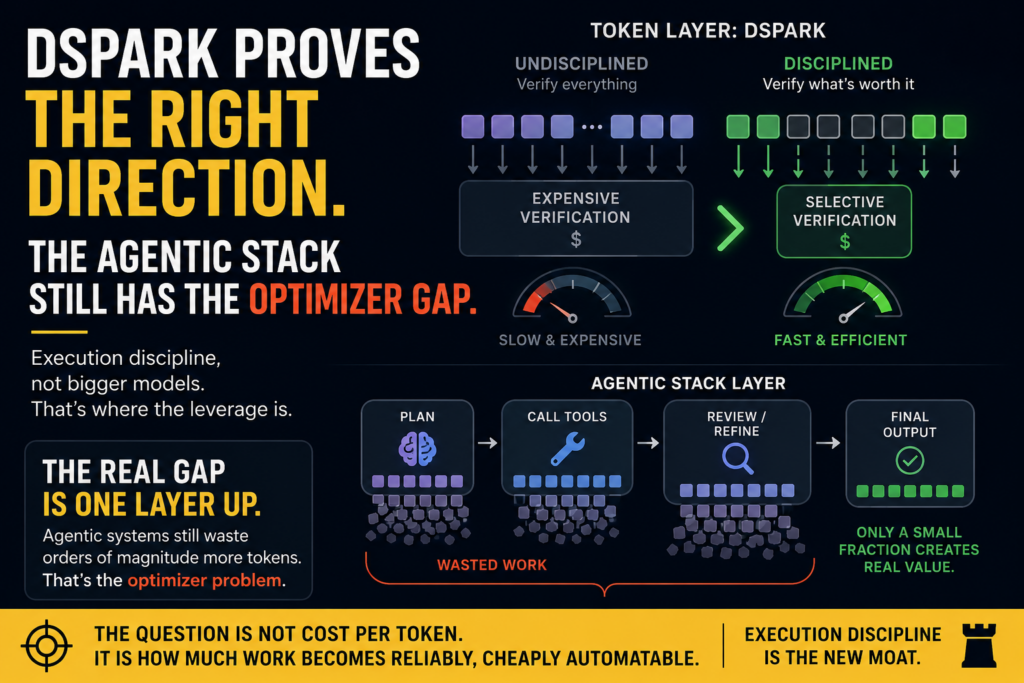
From DSpark to Disciplined Agentic AI What a database history lesson says about how much engineering is still left in AI infrastructure June 2026 — Chandra Pendyala ABSTRACT: DeepSeek’s DSpark is useful as more than a speedup number. Its gain comes from a small structural addition outside a frozen, pretrained model: draft cheaply, estimate survival, […]
From TensorFlow Legacy to Evaluation-Centric AI Systems

Re-Architecting Enterprise Threat Intelligence for the Foundation Model Era Chandra Pendyala Working Paper v5 14,000+Enterprise workloads processed ~60%Inference cost reduction per request Tens of thousandsProduction requests measured Executive Summary Dimension Result / Position Modernization trigger TensorFlow-era infrastructure cost pressure driving a migration of an existing production platform Production scale 14,000+ enterprise workloads across IaC, IAM, […]
Bridging the Agentic Reliability Gap:

From Pilot to Production February 2026 —- Chandra Pendyala Abstract: Do autonomous agents work? Yes — that question is settled. A better question is how well, and under what conditions. The most important question is how to create enterprise value today, not after AGI. This paper answers all three. We quantify where agents succeed and […]
Next Year in Enterprise AI: Pragmatic AI and Calculated Offense

As Yogi Berra said, “Predictions—especially about the future—are a tricky business.” So forget predictions. The only question that matters in 2026 is how enterprises spend AI money. One bucket is efficiency.LLMs are a new component —useful for drafting, search, summarization, and conversational interfaces.Paired with mature event-driven architectures, productized data, and reliable ML for speech, vision, […]
LLMs in Enterprises: Use Cases, Quick Wins, and Risk–Reward–Time-to-Value

by Chandra Pendyala This document was written to list use cases and discuss risk and rewards as frameworks. Most enterprises today still lack AI security, compliance, governance, and change management infrastructure, and we have deliberately excluded these critical considerations from this essay to focus narrowly on technical implementation patterns and their relative complexity. There are […]
A Practical History of Modern Machine Learning in Production

A curated account of research that actually crossed into large-scale deployed systems by Chandra Pendyala Abstract This article presents a curated timeline of machine learning research that demonstrably transitioned from academic publication into deployed, high-impact production systems. Rather than ranking papers by citation count or mathematical originality, this synthesis focuses on real-world operational impact—where a […]
The State of Enterprise AI in 2025: Time for scalable ROI delivery pipelines

by Chandra Pendyala The industry is awash in AI components—LLMs, vector databases, Snowflake and Databricks ecosystems, feature stores, MLOps stacks, copilots, and agent frameworks. Vendors have optimized their business model: sell the infrastructure and charge for usage. What remains far less clear is how enterprises convert those components into predictable, repeatable business value. Our experience this […]
Designing the Intelligent Enterprise: The Economic, Process, and Technical Architectures of Modern AI Systems

bt Chandra Pendyala Enterprise AI is finally becoming intelligible.Not because models grew larger or GPUs became cheaper, but because we now understand what actually produces value in real organizations. Frontier models are evolving rapidly across a broad set of capabilities, some of which may be orthogonal to enterprise workflows; this breadth naturally leaves gaps that […]
Mercedes-Benz, Autonomy – Systems First Vs. AI First Thinking.

by Chandra Pendyala On January 5, 2026, Mercedes-Benz announced MB.DRIVE ASSIST PRO—a supervised Level-2++ city-driving system for U.S. roads, priced at roughly $4,000 for three years. The internet response was predictable: debates about competitive positioning, whether this represents a “GSM moment,” and how it compares to Waymo or Tesla. That framing misses the point. The […]